
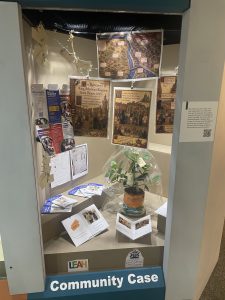
 This month, we are proud to present a Community Case display at Kingston Museum, developed in partnership with Kingston Museum and the Royal Borough of Kingston upon Thames.
The display celebrates the learning journey of our ESOL learners following a guided heritage walk organised as part of the 1,100th anniversary celebrations of the coronation of King Athelstan in 2025. (Read more about the trip here: LEAH (Learn English at Home) – Celebrating 1100 Years of King Athelstan: A Special Day in Kingston)
Titled “The Rediscovery of King Athelstan’s Kingston, Anno Domini 2025”, the display captures learners’ experiences of exploring Kingston’s royal heritage during the Athelstan 1100 celebrations. Bringing together history, language learning and community engagement, the project demonstrates how local heritage can help learners develop confidence, skills and a stronger connection to the place they now call home.
At the heart of the display is a creative interpretation of the learners’ historic walk through Kingston.
Photographs from the trip were transformed into a manuscript story, inspired by medieval illuminated texts. This creative interpretation enabled learners to retell their experiences of exploring Kingston’s historic sites in the style of a chronicle from King Athelstan’s time, bringing together local heritage, language learning and personal reflection.
The display also showcases accessible learning resources created to support learners’ engagement with Kingston Museum. These include easy-reading ESOL books about the museum visit, and an accompanying ESOL worksheet. The worksheet can be used during a visit to the museum, encouraging learners to explore exhibits, develop museum vocabulary and build confidence using English in a real-world setting. Together, these resources help learners strengthen their reading, comprehension and communication skills while engaging with Kingston’s rich heritage.
A historical map comparing Kingston in King Athelstan’s time with Kingston today helps visitors explore how the town has evolved over more than a thousand years, while highlighting its continuing importance in English history.
One of the display’s symbolic features is the inclusion of dried flax. Flax is known for its strength and durability when woven together, reflecting the resilience, determination and growth shown by our learners as they build their English language skills and establish new lives within the community. The flax also provides a connection to the period of King Athelstan, reminding us of the materials and traditions that shaped everyday life in early medieval England.
Another striking feature is the learner reflection tree. The tree is wrapped in cellophane, representing the safe and supportive environment that LEAH provides for learners as they develop confidence, share experiences and take risks in learning a new language. Hanging from the tree are messages written by learners in both English and their first languages, describing what they learned about Kingston, what they enjoyed about the project and how they connected their own experiences and cultural backgrounds with the history of the borough. The multilingual messages celebrate the diversity of our learner community while demonstrating the shared value of belonging, learning and cultural exchange.
The Community Case highlights the power of partnership between LEAH, Kingston Museum and the Royal Borough of Kingston upon Thames in creating meaningful opportunities for adult learners to engage with local heritage. Through this collaboration, learners have not only improved their English language skills but have also become active participants in preserving and sharing Kingston’s story.
We would like to thank Kingston Museum and the Royal Borough of Kingston upon Thames for their support and for providing a platform to showcase the creativity, achievements and voices of our learners. We are also grateful to Kingston Council for the funding opportunity that helped make this project possible and enabled learners to engage with Kingston’s rich heritage in meaningful and accessible ways.
A huge thank you to our volunteer Lana for all her help. After four and a half hours, several deep breaths, and a few moments of wondering if the display would ever cooperate, we finally got there!
We hope the display inspires visitors to explore Kingston’s history and recognise the important contribution that learners from diverse backgrounds make to our community.
You can access the resources by clicking on the links below:
ESOL Worksheet to use in Kingston Museum